Stripe Account Frozen? What to Do in the First 24 Hours
First establish whether Stripe has paused payouts, placed a reserve, disabled payments, or closed the account. Preserve your records, answer the exact information request, protect customer fulfilment, and prepare a separately underwritten backup payment method. Do not create a disguised replacement account.
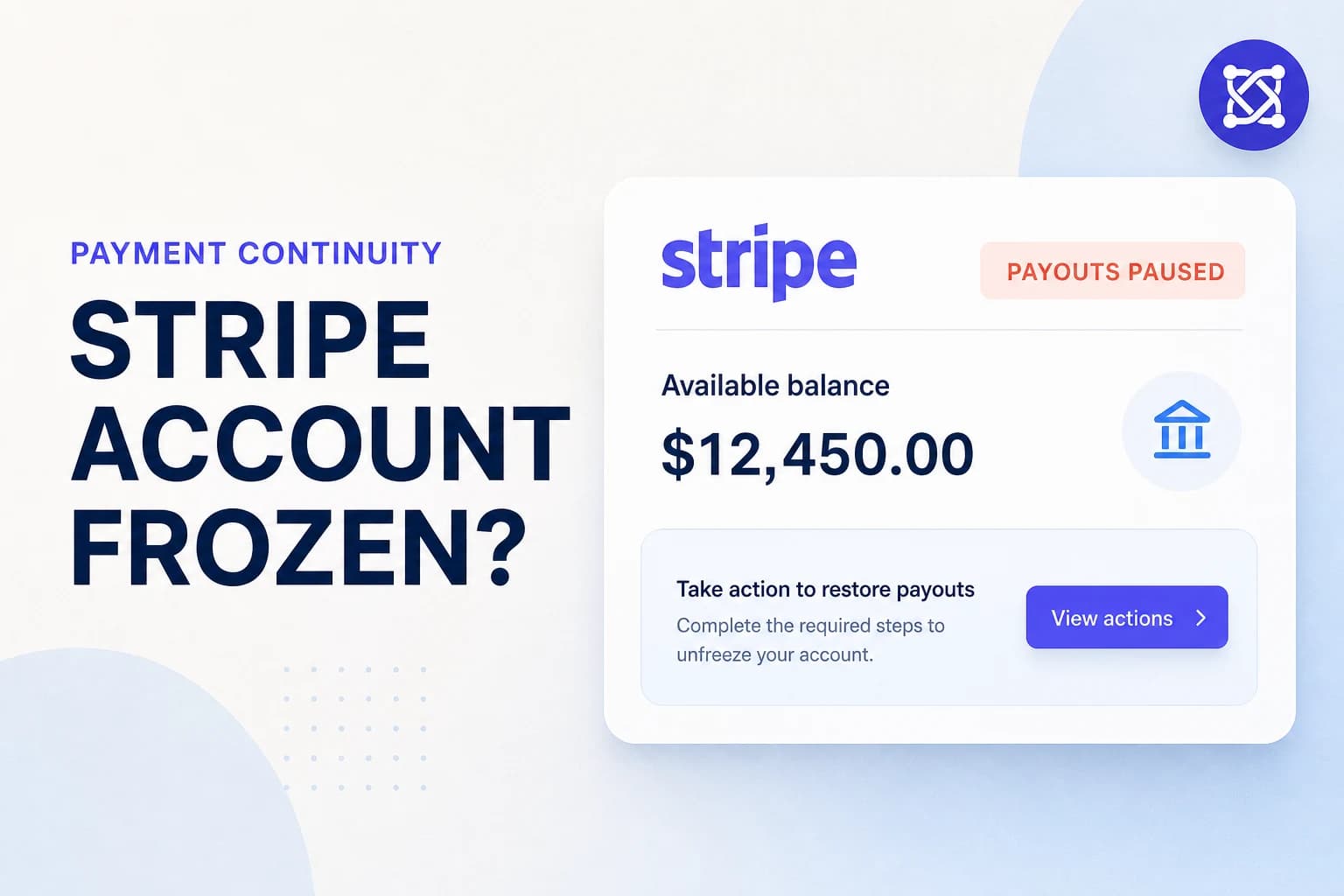
A frozen Stripe account is not one single condition. It may mean card payments are disabled, payouts are paused, a fixed or rolling reserve has been imposed, identity verification is incomplete, or Stripe has decided to terminate the relationship. The correct response depends on which of those actually happened.
First, identify what “frozen” means
Open the Stripe Dashboard directly and record the exact language shown under balances, payouts and account status. These situations are operationally different:
| What you see | What it usually changes | First response |
|---|---|---|
| Payments disabled | New card charges cannot be accepted | Read the account-status request and stop sending customers into a broken checkout |
| Payouts paused | Existing balance is not reaching the bank account | Check whether Stripe or the receiving bank requested information |
| Reserve imposed | A percentage or fixed amount is withheld against future refunds and disputes | Record the percentage, duration and release terms; check whether an appeal is offered |
| Verification required | Service is limited until business or identity information is confirmed | Provide current, consistent documents through the Dashboard |
| Account closure | The processor relationship is ending | Preserve reports, confirm the payout timetable and move future sales to an approved alternative |
Stripe says reserves can be fixed or rolling and are intended to cover refunds and disputes. When an appeal is available, Stripe asks merchants to provide detailed supporting documentation. A useful response should include fulfilment records, supplier invoices, the refund policy, relevant customer communications and a clear explanation of the business model.
What to do in the first hour
- Take a dated record of the notice. Save the wording, affected services, balances, reserve terms and any response deadline. Do not publish customer data or sensitive account screenshots.
- Confirm the notice inside Stripe. Phishing messages often create urgency around suspended payouts. Navigate to the Dashboard yourself instead of signing in through an email link.
- Separate incoming payments from existing funds. Determine whether customers can still pay and whether completed charges can still be paid out. Treat those as two different workstreams.
- Stop making promises your checkout cannot keep. If new charges are disabled, remove or replace the payment button. If cash flow is constrained, avoid accepting orders whose fulfilment now depends on unavailable settlement funds.
- Export what remains accessible. Download balance, payout, dispute, refund, customer and transaction reports. Keep your own order system as the primary record of what each payment purchased.
Do not close the account while scheduled payouts or an appeal remain unresolved. Stripe warns that closing an account removes Dashboard access and can make failed scheduled payouts harder to investigate.
Build the documentation package before replying
A long emotional explanation is less useful than a short statement backed by documents. Build one folder containing:
- Your legal entity name, registration and beneficial-owner information.
- A plain-language description of the product or service actually being sold.
- The website URLs, checkout flow, pricing and refund terms customers saw.
- Supplier invoices or proof that you can fulfil open orders.
- Tracking, delivery, access or completion records for recent transactions.
- Refund and dispute history, including any recent spike and its cause.
- Customer-support contact details and examples of resolved complaints.
- Licences or authorisations required for a regulated activity.
- An explanation of any recent change in volume, average order value, geography or fulfilment time.
Consistency matters. A website describing “consulting,” invoices describing “digital access,” and an application describing “software” can look like three businesses even when the owner considers them one. Explain the relationship instead of forcing the reviewer to infer it.
Appeal the decision you actually received
Use the appeal or information-request path shown in the Dashboard. Answer each question in the same order and attach the documents that support that answer.
If the issue is a reserve, document why the expected refund and dispute exposure is lower than the reserve assumes. If the issue is a restricted category, provide the relevant licence and an exact description of what is and is not sold. If the issue is a payout failure, check the receiving bank details and ask the bank whether the account is active and able to receive the transfer.
Avoid claiming that a business is “low risk” as if that settles the matter. Processors assess several kinds of exposure: chargebacks, fraud, fulfilment delays, regulatory requirements, business-model changes and the possibility that future refunds exceed the merchant balance.
What not to do
- Do not open a disguised duplicate account. Misstating the owner, website, product or merchant behind transactions can create a second closure and a more serious compliance problem.
- Do not route sales through an unrelated person’s account. That can amount to undisclosed payment aggregation or transaction laundering.
- Do not refund outside the processor without reconciling the original charge. You can accidentally pay the customer twice if a card dispute or processor refund follows.
- Do not delete the customer-facing website. Reviewers need to understand the offer, fulfilment and policies that generated the transactions.
- Do not assume a stablecoin rail is outside compliance. It changes settlement mechanics; it does not make an illegal or misleading business acceptable.
Stripe’s published restricted-business policy says some lawful categories require additional due diligence and that approval can be modified or revoked. It separately prohibits illegal activity and deceptive use of Stripe accounts. “Restricted” and “illegal” are not synonyms, but neither is “restricted” a promise of approval.
Keep customers and cash flow under control
Make a list of every open order and divide it into three groups: already funded and fulfilable, paid but at risk of delay, and not yet paid. Contact affected customers before they have to chase you. Clear communication and voluntary refunds can reduce the disputes that make the risk review worse.
Prepare a thirteen-week cash-flow view using money actually available—not the full processor balance. Include expected refund exposure, supplier payments, payroll and tax obligations. If a reserve or payout pause threatens solvency, speak to a qualified accountant or lawyer in your jurisdiction rather than relying on a blog post.
Add a backup payment rail without misrepresenting the business
The best time to arrange payment redundancy is before an account review. After a freeze, the next-best time is after you have documented the business accurately.
A backup can be another card processor that explicitly underwrites your category, bank transfer, open-banking payment, invoice payment, or a direct stablecoin payment. The correct choice depends on customer preference, geography, refund expectations and the licences your business requires.
For a lawful business whose customers already use stablecoins, direct settlement can reduce reliance on a processor-controlled merchant balance. But it introduces different responsibilities: wallet security, irreversible transfers, refunds, accounting, customer support and sanctions compliance. USDC is also not literally “unfreezable”; Circle publishes blocklisting and compliance powers in its terms.
The durable lesson is not “replace Stripe with one new dependency.” It is to avoid allowing any single checkout, processor, bank account or wallet to become an undocumented point of failure.
Where GenesisPay fits—and where it does not
GenesisPay is building non-custodial USDC and EURC payment links. Money moves from the payer to the seller’s wallet instead of accumulating in a GenesisPay merchant balance. It can become one backup rail for a lawful, supported business.
GenesisPay cannot recover funds held by Stripe, reverse a processor decision, conceal the nature of a business, or make a prohibited activity acceptable. The product is currently a testnet beta, so it should be evaluated as a future continuity option rather than an emergency production replacement today.
Frequently asked questions
Can Stripe legally hold my money?
The answer depends on your contract, location, the reason for the hold and applicable payment-services law. Stripe’s published terms describe reserves, payout pauses and withholding related to disputes and risk. Obtain jurisdiction-specific legal advice if the amount is material or the stated release terms are not followed.
How long does a Stripe reserve last?
There is no universal duration. The reserve notice should state whether the reserve is fixed or rolling, how much is withheld and when funds are expected to be released. Record those terms and use the Dashboard appeal process when one is available.
Should I immediately refund every customer?
Not automatically. Reconcile open orders, fulfilment capability and processor status first. An uncoordinated external refund can be followed by a processor refund or card dispute. Prioritise customers whose orders cannot be fulfilled and keep a record of every decision.
Can I use another Stripe account?
Do not create an account that disguises the same owner or business. If you operate a genuinely separate legal business, obtain professional advice and disclose it accurately. Stripe’s rules prohibit misleading business information and undisclosed processing for another merchant.
Are stablecoin payments a guaranteed way to avoid freezes?
No. Direct wallet settlement removes the merchant-balance structure used by many processors, but stablecoin issuers, wallet providers, exchanges and authorities still enforce legal and compliance controls. Stablecoin payments are an additional rail, not a compliance escape hatch.
Primary sources
Check the original sources.
- 01Prohibited and restricted businessesStripe
- 02Reserves: frequently asked questionsStripe Support
- 03Stripe Services Agreement overviewStripe Support
- 04Using payment service providersUK Financial Conduct Authority
- 05USDC terms: blocked addresses and complianceCircle
Last source review: Jul 23, 2026. This is technical education, not financial or legal advice.