A signed USDC authorization is not a blank cheque.
Gasless payment can sound like control has moved away from the payer. EIP-3009 does the opposite when it is implemented carefully: the signed message names the transfer’s exact boundaries.
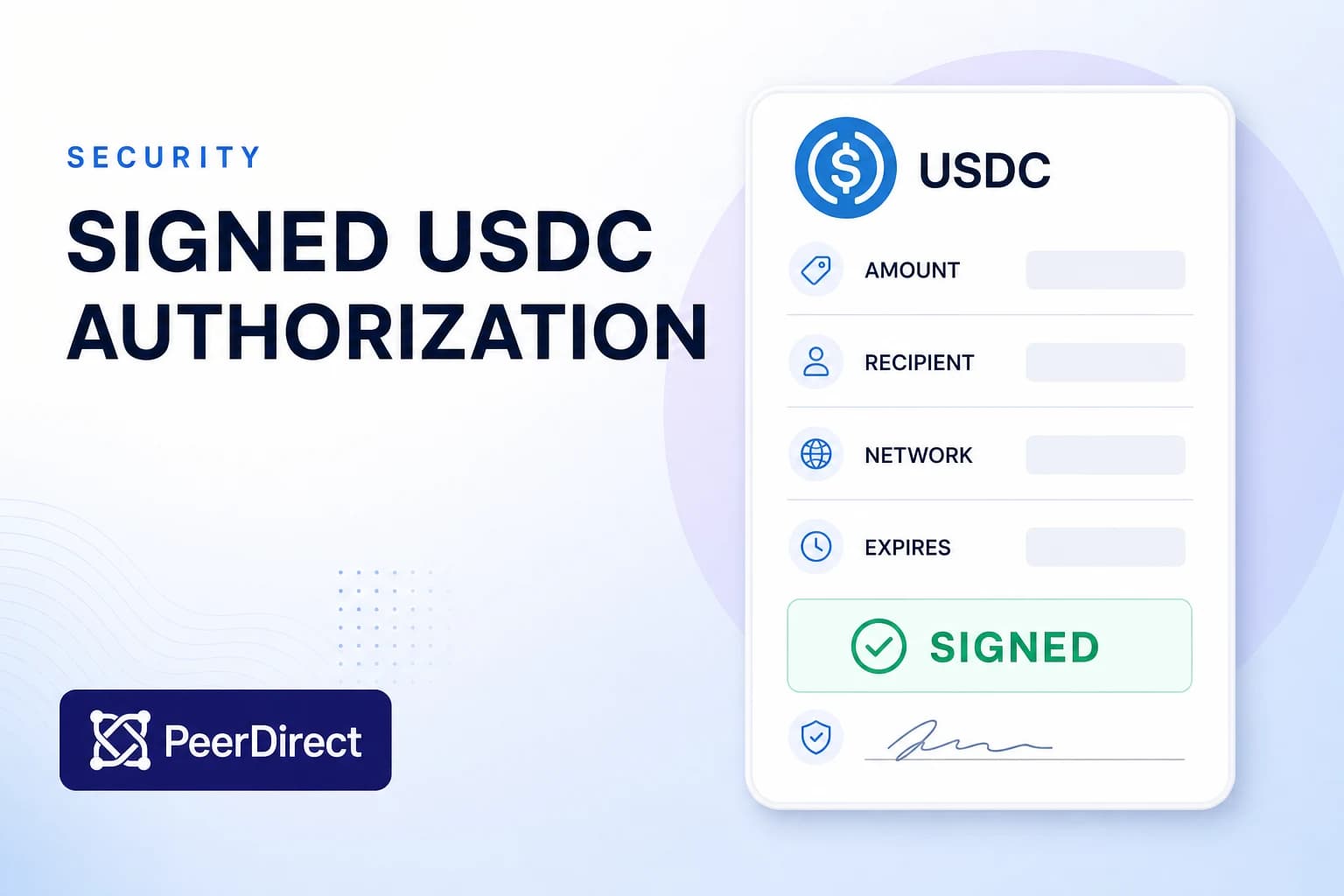
The six fields that bound a transfer
transferWithAuthorization carries from, to, value, validAfter, validBefore and a 32-byte nonce. The EIP-712 signature also commits to a domain containing the chain ID and verifying contract. Change a committed value and the signature no longer verifies.
This is materially different from granting an open-ended token allowance. The signed message authorizes one defined transfer during one defined window.
- from — the wallet that signs and funds the transfer.
- to and value — the exact recipient and amount.
- validAfter and validBefore — the time window in which it can execute.
- nonce — a unique identifier that must not be accepted twice.
- EIP-712 domain — the chain and token contract for which the signature is valid.
Gasless for the payer does not mean off-chain settlement
The payer signs typed data rather than broadcasting a transaction. A relayer or facilitator can submit the authorization and pay the network fee. The token contract then checks the signature, time window and nonce before moving funds on-chain.
Circle’s documentation uses the same pattern for USDC payment authorizations: signing happens off-chain, while execution and nonce consumption happen through the contract or settlement system.
Where verification fails in practice
Most risk sits around the signature, not inside the cryptography. A client can sign the wrong chain or token contract. A server can neglect to compare the signed recipient or value with its own requirement. An overly long validity window increases exposure if a payload leaks.
The EIP also warns contract integrations about front-running when transferWithAuthorization is embedded in a larger wrapper flow. For those cases, receiveWithAuthorization adds a caller-is-payee check. That nuance matters when a payment is meant to trigger another on-chain action atomically.
GenesisPay verification boundary: Before settlement, GenesisPay compares the signed resource, network, asset, destination, amount and validity window with the advertised requirement, then verifies the EIP-712 signature. A mismatch is a failed payment, not a partial success.
What to show a payer
A safe signing experience should surface the human meaning of the typed data: who will receive funds, how much, in which asset, on which network and until when. Raw hex is useful for audit logs, but it is not informed consent on its own.
Primary sources
Check the original sources.
- 01ERC-3009: Transfer With AuthorizationEthereum Improvement Proposals
- 02How to sign EIP-3009 payment authorizationsCircle Developers
- 03Meta-transaction signatures without expirationOWASP Smart Contract Security
Last source review: Jul 22, 2026. This is technical education, not financial or legal advice.