What Makes a Business High Risk to Payment Processors?
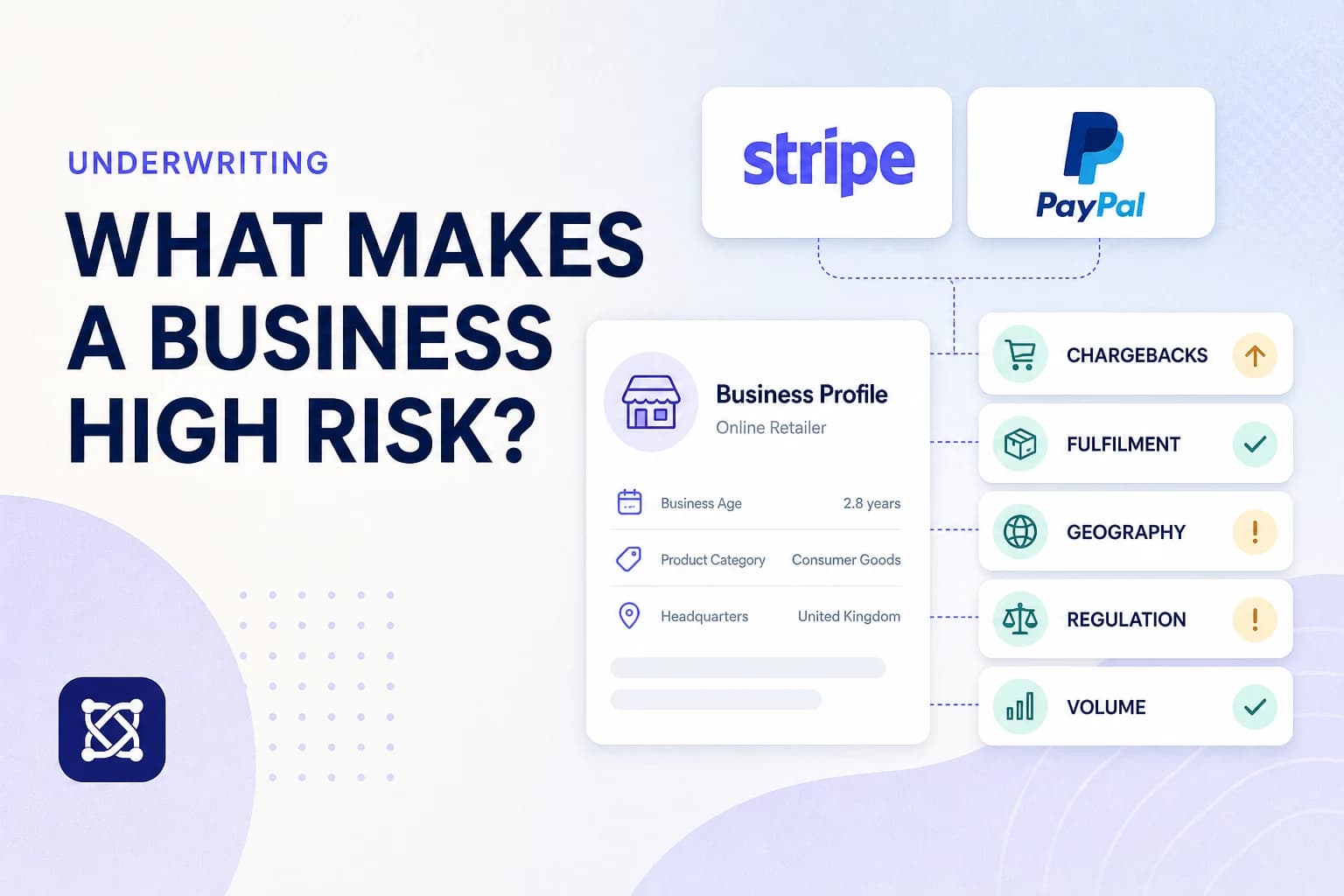
A business can be legal and still be classified as high risk. Processors look at future refund and dispute exposure, fraud patterns, fulfilment time, regulation, transaction size, geography and whether the real business matches the original application.
High risk is a prediction about future losses
A card payment is not economically finished when the merchant receives a payout. The customer may later dispute it, the merchant may owe a refund, or a network or regulator may require action. The processor and acquiring bank therefore assess whether future liabilities could exceed the money still available in the merchant account.
That is why two businesses selling lawful products can receive different terms. A local shop delivering goods immediately may create less future exposure than an online seller taking annual subscriptions or deposits months before fulfilment.
The result is not always a rejection. It can be additional underwriting, lower processing limits, slower settlement, a fixed reserve, a rolling reserve or closer monitoring.
The seven signals processors examine
1. The product and its regulatory requirements
Some categories require licences, age checks, prescription controls or jurisdiction-specific disclosures. Others attract more complaints or card-network scrutiny. Stripe’s published policy separates prohibited businesses from restricted businesses that may require additional due diligence and explicit approval.
Approval is provider-specific. Being lawful does not force a processor or acquiring bank to support the category, and one provider’s approval does not transfer to another.
2. The time between payment and delivery
Advance sales, pre-orders, travel, event tickets, custom manufacturing and annual subscriptions create a long exposure window. If the seller fails before delivery, many customers may seek refunds or disputes at once.
Show underwriters the actual fulfilment timeline, supplier capacity and the cash needed to complete open orders. Hiding a six-month delivery window behind the word “ecommerce” prevents the reviewer from pricing the real risk.
3. Chargebacks, refunds and customer complaints
Dispute volume matters, but the reason matters too. Fraud claims suggest different controls from “product not received,” “not as described” or “subscription cancelled.” A business that only tracks the total percentage cannot show how it is fixing the underlying problem.
Visa’s monitoring programme combines fraud and dispute signals, while Mastercard maintains its own chargeback and merchant-monitoring rules. Network thresholds can change; use the current programme documentation and ask the acquirer which calculation applies to your account.
4. Card-not-present fraud and transaction testing
Online payments are easier to automate and attack than an in-person chip transaction. A sudden burst of small authorisation attempts can be card testing rather than real demand. Weak velocity controls, no address checks and an exposed checkout increase the processor’s expected fraud loss.
PCI DSS also remains relevant when payment collection is outsourced. The PCI Security Standards Council says merchants retain responsibilities for selecting and monitoring compliant providers and validating the requirements that apply to their setup.
5. Transaction size, volume and growth pattern
Large tickets create a larger loss when one transaction is disputed. Sudden growth can be healthy, but it can also mean the business now exceeds the volume originally underwritten. A sharp change in average order value, countries, refund behaviour or sales channel can trigger review.
Forecast honestly. Asking for a low monthly limit to obtain approval and then immediately processing ten times that amount looks less like growth than misrepresentation.
6. Geography and settlement structure
Cross-border sales add sanctions, local-law, currency and fraud complexity. The legal entity, beneficial owners, customers, suppliers, bank account and fulfilment locations may all be evaluated. A provider may support the product in one country and decline it in another.
7. Whether the real business matches the application
Business-model mismatch is one of the most preventable risks. Moving from first-party software to a marketplace, adding third-party sellers, introducing a regulated product or processing for another company changes who is being paid and what the processor is underwriting.
Tell the provider before a material change. Do not rely on a vague descriptor such as “consulting” when the website, invoices and customer experience show something more specific.
Restricted, high risk and prohibited are different
| Label | What it usually means | Practical response |
|---|---|---|
| Standard risk | Fits automated onboarding and ordinary monitoring | Keep information and policies current |
| Elevated or high risk | Greater expected dispute, fraud, fulfilment or regulatory exposure | Use an individually underwritten account and understand reserves and limits |
| Restricted | Provider may require explicit approval, licences or enhanced due diligence | Obtain written approval for the exact product, country and payment flow |
| Prohibited | Provider will not support the activity under its rules | Do not process it through that provider or disguise it |
| Illegal | Activity violates applicable law | No payment rail makes it acceptable |
What underwriters commonly request
Prepare one consistent application file before applying:
- Legal entity and beneficial-owner documents.
- A live website showing the real product, price and billing terms.
- Refund, cancellation, shipping and privacy policies.
- Supplier invoices, licences and proof of fulfilment capability.
- Three to six months of processing and bank statements when available.
- Chargeback and refund data with an explanation of any spike.
- Expected monthly volume, average and maximum ticket, countries and currencies.
- Customer-support contact details and a recognisable billing descriptor.
The purpose is not to make the business look generic. It is to let the underwriter understand the actual exposure without guessing.
How to reduce the risk without changing the truth
- Shorten the fulfilment gap. Take smaller deposits, bill closer to delivery or separate milestones when the business model allows it.
- Make cancellation easy to find. Clear terms and responsive support can prevent ordinary requests becoming card disputes.
- Use fraud controls proportionately. Combine authentication, velocity limits and manual review for unusual orders instead of blocking every good customer.
- Reconcile the billing descriptor. Customers should recognise the name on their statement and be able to contact the seller.
- Track disputes by reason. Fix the process generating the loss rather than treating every chargeback as friendly fraud.
- Notify material changes. New products, countries, ownership, fulfilment periods and marketplace activity may require fresh approval.
- Build accurately disclosed redundancy. A second underwritten card account, bank payment or direct-settlement rail can reduce a single point of failure.
Where direct stablecoin settlement changes the risk
Direct settlement does not create a processor-held merchant balance, so it changes reserve and payout exposure. It can also remove card chargebacks at the payment-rail level. But the seller still owes refunds, consumer rights, tax, sanctions screening, truthful marketing and secure wallet operations.
USDC is not literally unfreezable. Its issuer publishes blocklisting and legal-compliance powers. A stablecoin rail is a different risk model, not an exemption from law or customer obligations.
Frequently asked questions
Can a startup be classified as high risk without chargebacks?
Yes. With no processing history, an underwriter relies more heavily on the industry, owner, financials, fulfilment model, ticket size and forecast. A specialist provider may approve a startup with conservative limits or a reserve.
Does high revenue automatically make a business high risk?
No, but a high monthly volume or large maximum ticket increases the processor’s potential exposure. Growth that is inconsistent with the application or available working capital receives closer attention.
Will a rolling reserve guarantee approval?
No. A reserve can reduce expected financial loss, but it cannot solve prohibited activity, missing licences, misleading information, sanctions risk or an unacceptable business model.
Is a high-risk merchant account permanent?
Terms can be reviewed. A stable processing history, lower dispute exposure and stronger financials may support better pricing, limits or reserve terms, but changes require the acquiring bank’s agreement.
Primary sources
Check the original sources.
- 01Prohibited and restricted businessesStripe
- 02Reserves: frequently asked questionsStripe Support
- 03Visa Acquirer Monitoring Program overviewVisa
- 04Security Rules and Procedures—Merchant EditionMastercard
- 05PCI Data Security StandardPCI Security Standards Council
Last source review: Jul 23, 2026. This is technical education, not financial or legal advice.